
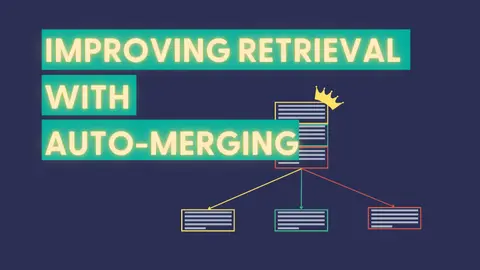
Improving Retrieval with Auto-Merging
For most RAG applications, where we first have to retrieve the most relevant context, we end up having to split up documents first, and index those smaller splits of documents.
Haystack Blog9 min read
65 stories
For most RAG applications, where we first have to retrieve the most relevant context, we end up having to split up documents first, and index those smaller splits of documents.
DeepLearning.AI and Andrew Ng hold a special place in many AI/ML engineers’ careers and development. For many engineers, they’ve played a pivotal role into breaking into AI, or extending their knowledge and capabilities by teaching about core concepts and technologies at the right time.
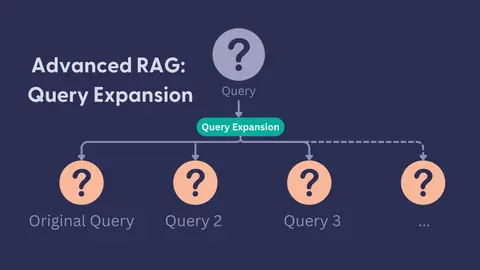
This is part one of the Advanced Use Cases series: 1️⃣ Extract Metadata from Queries to Improve Retrieval 2️⃣ Query Expansion 3️⃣ Query Decomposition 4️⃣ Automated Metadata Enrichment The quality of RAG (retrieval augmented generation) highly depends on the quality of the first step in the process:…
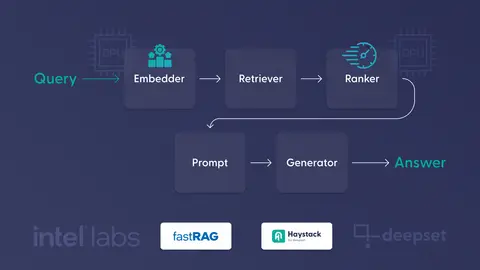
One of the main and critical components of a retrieval augmented generation (RAG) pipeline is the embedding process, which forms the foundation for efficient information retrieval by transforming raw text into machine-readable vector representations.
It’s 2024 and yet, most models today are still primarily geared towards English speaking markets. Today, deepset and Mixedbread are jointly announcing our latest contribution towards changing that landscape: A new open-source German/English embedding model - deepset-mxbai-embed-de-large-v1.
In this article, we will show you how to use Haystack to evaluate the performance of a RAG pipeline. Note that the code in this article is meant to be illustrative and may not run as is; if you want to run the code, please refer to the python script.

When building real-world applications based on Language Models (such as RAG), evaluation plays an important role. Recently, evaluating generated answers using powerful proprietary Language Models (such as GPT-4) has become popular and correlates well with human judgment, but it comes with its own…
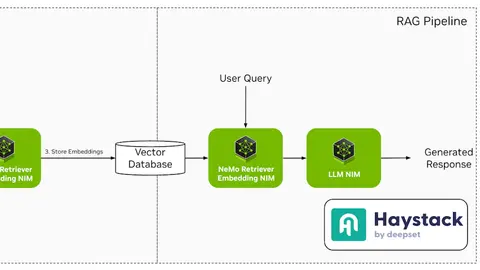
Retrieval-augmented generation (RAG) systems combine generative AI with information retrieval for contextualized answer generation. Building reliable and performant RAG applications at scale is challenging.
Getting your LLM application into production is a huge milestone, but that’s only the beginning. It’s critical to monitor how your pipeline is performing in the real world so you can keep improving performance and cost, and proactively address any issues that might arise.

This is part one of the Advanced Use Cases series: 1️⃣ Extract Metadata from Queries to Improve Retrieval 2️⃣ Query Expansion 3️⃣ Query Decomposition 4️⃣ Automated Metadata Enrichment In Retrieval-Augmented Generation (RAG) applications, the retrieval step, which provides relevant context to your…

Let’s talk about how we build AI applications that can interact with, even chat to SQL databases. Heads-up that this is a mini project that I tried out, and it’s objectively a simple approach to interacting with SQL with natural language.
Showing 65 of 65 stories
You're all caught up.
Get the top AI news and tools straight to your inbox every week.
Weekly · AI news
Join 15,000+ AI enthusiasts