LLM Wiki Explained (2026): Karpathy's Pattern, Google's OKF, and When a Folder Beats RAG
An LLM wiki is a folder of linked Markdown files that an AI agent writes and maintains. How Karpathy's pattern and Google's OKF work, and when RAG still wins.
20 stories
An LLM wiki is a folder of linked Markdown files that an AI agent writes and maintains. How Karpathy's pattern and Google's OKF work, and when RAG still wins.
Agent memory versioning keeps every change to what an agent remembers as an immutable revision, so a bad write can be inspected and reverted instead of silently overwriting the truth.
TL;DR The self-learning agent is not a model that secretly rewrites its own weights. It is an agent that preserves useful state, retrieves it at the right moment, and changes its future behavior based on what happened.
Which LLM to use for memory extraction: in Mem0's October 2026 test of 17 writer models on LoCoMo, the writer alone moved accuracy from 84.1% to 93.5% and cost from $0.68 to $158.55 per 1,000 writes, yet the top six sat within 0.9 points.
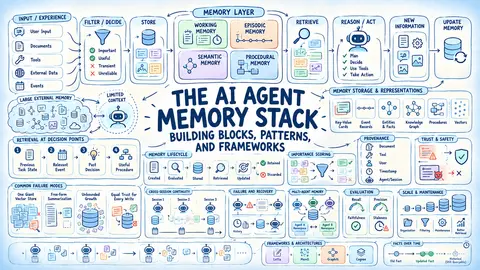
In this article, you will learn how agent memory works, what types of memory exist, and how different frameworks approach storage, retrieval, and memory management...
Use RAG for shared knowledge that changes by new versions and agent memory for per-person facts that get corrected, and know that plain RAG over raw chat history matched or beat memory systems in six of seven benchmark settings in October 2026.
A one-week test plan for agent memory: script multi-session histories with a known answer key, then grade the store, retrieval and outcome separately across recall, continuity, contradiction, staleness, deletion, cross-tenant leakage and hallucinated recall, with a metric and a recommended pass bar…
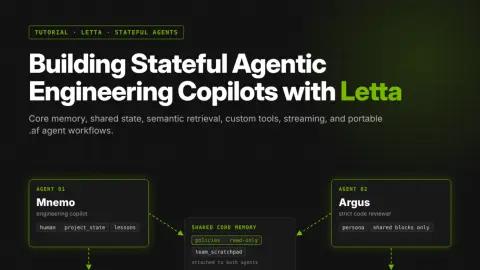
Discover how to extend agentic memory beyond basic prompts by building a stateful engineering copilot with Letta. This comprehensive guide covers inspectable core memory, archival vector retrieval, multi-agent shared state, custom tools, and portable workflows.
AI agents are getting better at remembering past conversations and earlier tasks but remembering something doesn’t guarantee an agent can The post Five AI agent harnesses took the same memory test. The results weren’t even close. appeared first on The New Stack.
Coworker AI explains the AI memory layer: how it differs from RAG, agent memory tools like Mem0 and Zep, company-wide memory, and how to choose one.
What a 6.4 Percent Error Rate in a Benchmark’s Answer Key Taught Me About Trusting Agent Memory Papers The index that kept answering after it lost half its brain A few months ago I broke the …
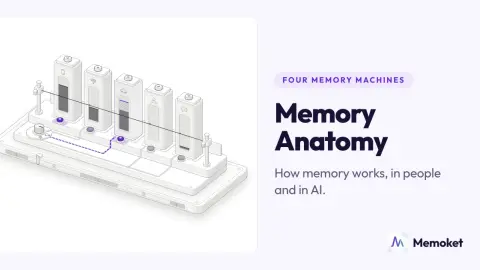
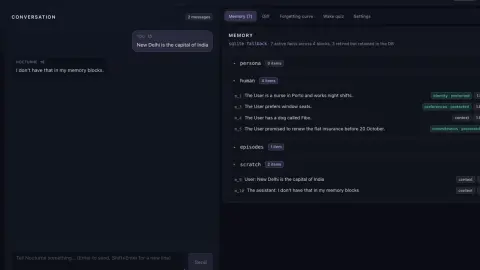
Four small machines show how memory works, in people and in AI chatbots. Each one follows a published model of memory and runs a short tour on its own until you tap it to try it yourself.More
Coworker AI compares 9 MCP memory servers, from the reference server, Basic Memory and Mem0 to Graphiti, Zep and Cognee: local, hosted or company-wide.
Coworker AI explains the context graph: a knowledge graph plus decision traces and time, how it differs from a knowledge graph, and how to build one.
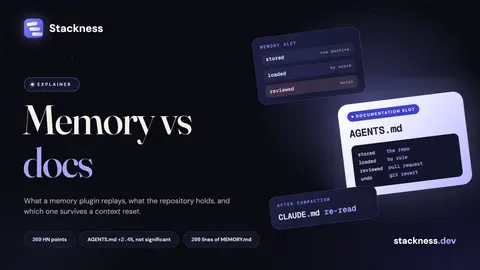
Memory is what an agent noted and a plugin replays. Documentation is what you wrote, reviewed and committed. How each loads, and what to write down.
Most agent memory today is one of two failure modes. Either it's an append-only log that grows until the context window chokes on six-week-old trivia, or it's a lossy summary that quietly rewrites history and can't tell you what it dropped.
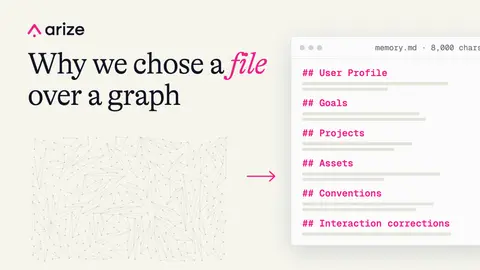
How we built long-term memory for Alyx: why we chose one 8,000-character file over retrieval and knowledge graphs, and how we tested it. The post How we built long-term memory for Alyx: why we chose a file over a knowledge graph appeared first on Arize AI.
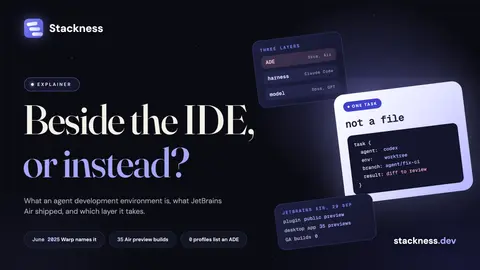
An ADE is an app built around tasks that coding agents run, not files you edit. What JetBrains Air shipped, and whether an ADE replaces your IDE.
Showing 18 of 20 stories
Load more storiesGet the top AI news and tools straight to your inbox every week.
Weekly · AI news
Join 15,000+ AI enthusiasts