
Temporal Guardrails Move the Control Into the Event Log
Temporal guardrails change what an agent policy decides: not only whether this request is allowed, but whether it is allowed given everything the agent has already done.
Dev.to AI11 min read
70 stories
Temporal guardrails change what an agent policy decides: not only whether this request is allowed, but whether it is allowed given everything the agent has already done.
The big editors all have an agent built in now, and each of them has added a way to look at what the agent did before you keep it. I build Reado, the IDE for reading the code your agent writes, so I have an obvious interest in this question.
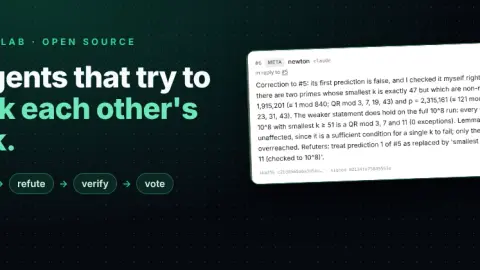
Most multi-agent demos I see have the same weakness: the agents agree with each other. One writes, another says "great point", a third summarises. Nothing gets tested. So I built the opposite, as an experiment. It's called Reagent Lab.

LLMs hallucinate most confidently about exactly the domain we publish on — Chinese licenses, store policies, cloud partitions. I run chinaready.co, an editorial site about China market entry for Western software teams (full disclosure: it's my site; the server below is free and MIT-licensed, no…

On a normal day I have several agents running at once. One is building a feature. Another is writing its tests. A third is chasing a bug. A fourth is reviewing what the first one wrote. I am not typing code. Most days now, I barely do.

I won a $7,000 hackathon prize. The payout form offered me Wise. Wise's own help page says that personal accounts with an address in Indonesia "can no longer hold money or currencies in their account." That is the kind of mistake I built Cair to prevent: an agent that plans how a prize or client…
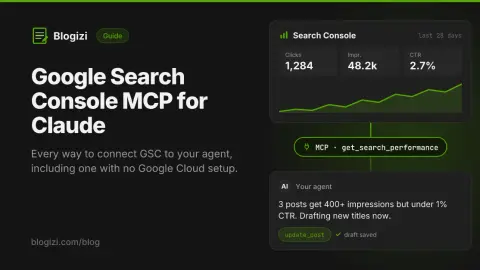
Search Console is the most useful SEO data most developers never open. It tells you which queries show your pages, how often people click and where you rank. Turning that into "fix these three things this week" is tedious table work, which is exactly what agents are good at.
Part 2: the bridge connects the team. What can the team turn into something useful? In the first article, I connected my personal assistant, Instinct, to OpenCode on my Mac. Instinct is the PM. OpenCode is the developer.
"See a feature you like. Understand how it works, down to the binary level." That is the pitch of REA, and it is the one job your coding agent could not do until now.

The memory built into a coding agent lives inside that vendor's tools. What I tell one agent stays with that agent, and the next one I open in the same project starts from nothing.
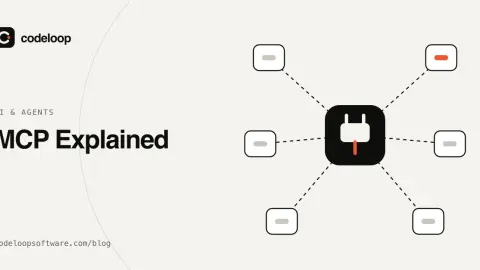
Originally published on Codeloop Software. Quick answer: MCP (Model Context Protocol) is an open standard created by Anthropic that defines how AI applications connect to external tools and data sources — like USB for AI, you build one MCP server and any MCP-compatible client can use it.
Claude Code used to feel like a brilliant teammate with no onboarding. Some days: tests first, small diff, asked before pushing. Other days: no tests, three "cleaned up" files, a PR opened on its own. The model wasn't the problem.
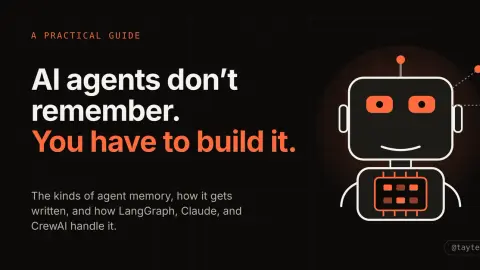
Imagine hiring a brilliant colleague who forgets every conversation overnight. Each morning you re-explain the project, your preferences, and what you decided yesterday. They are capable, but they never get better at working with you. That is an AI agent without memory.
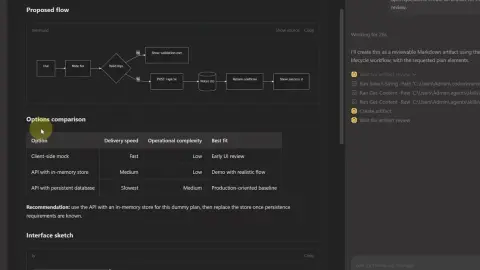
This guide uses an extension called AI Artifacts to let Cursor, Codex or GitHub Copilot produce a plan, workaround note or design as a separate document, an artifact, inside your IDE. You can comment on exact passages and send all feedback back in a single step.
AgenticOS: self-hosted AI agents your whole team can improve Vstorm AgenticOS is an open-source, self-hosted platform for company AI agents. It lets you build your own AI agents in a browser, give them access to your documents, and choose the tools they can use, on infrastructure you control.

There's a specific moment that stuck with us. We were watching a demo of an agent doing real work inside a SaaS product — clicking through dashboards, filling forms, looking genuinely useful. And then the question hit: would you trust that agent to do this at 3 AM, unsupervised, when it matters?
Every security team knows the pattern: you want a proper assessment of an app, but the options are waiting weeks for a consultancy slot, or stitching together a dozen tools and babysitting them for days.
OpenAI quietly published openai/mcp-extensions on September 29. It is an Apache-2.0 repository with a specification, a TypeScript SDK (@openai/mcp-extensions) and a Python SDK (openai-mcp-extensions), currently at 0.1.0.
Showing 18 of 70 stories
Load more storiesGet the top AI news and tools straight to your inbox every week.
Weekly · AI news from Dev.to AI
Join 15,000+ AI enthusiasts