
Pushary Isle: your agents' questions, in your Mac's notch
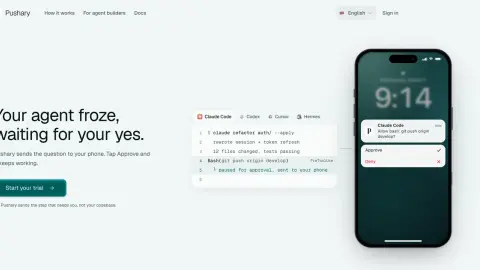
Pushary Isle is a small native Mac app. When Claude Code, Codex or Cursor stops to ask you something, the question shows up in your notch and one shortcut answers it.
Pushary Blog5 min read
30 stories
Pushary Isle is a small native Mac app. When Claude Code, Codex or Cursor stops to ask you something, the question shows up in your notch and one shortcut answers it.
Every guide says auto-approve under $100 and escalate above it. That is the easy part. Four properties decide whether an approval threshold survives contact with production.
What it actually takes to build agent approvals in-house: delivery, enrollment, pending state, fail-closed timeouts, recovery, and audit, itemized honestly.
An agent approval that assumes yes on timeout is an approval in name only. The case for fail-closed defaults, and what it takes to implement them.
Add a human approval step to a Vercel AI SDK agent with @pushary/ai-sdk: an askHuman tool that reaches a person on their phone and blocks until they decide.
Notification APIs consider the job done at delivery. An agent approval's job starts there: hold the agent, collect the answer, fail closed, keep the record.
Two working patterns for LangGraph human-in-the-loop with Pushary: a blocking decisions.ask tool inside a node, and interrupt() with a webhook-driven resume.
Cowork does real work unattended, and for individuals it keeps no reviewable record of what was asked and approved. Here is how to get one.
Cowork pauses on questions and approvals, and if you stepped away it just sits there. Route those moments to your phone so tasks finish while you are gone.
Answer Cowork's questions and go-aheads from your lock screen: paste one connector link, add standing instructions, and every session reaches you anywhere.
A container keeps your agent off the disk. It does nothing once the agent reaches past it. Here is the line worth drawing, plus the classifier code that enforces it.
AI Plaza sat down with our founder to talk about why an agent should tell you the moment it is done, and how to keep a person in the loop without slowing the work down.
A useful AI agent audit log records the action, arguments, decision, who approved it, and which surface. Here is what to capture, and the honest limits.
Gemini CLI and Codex now have native Pushary hooks, and setup writes a proactive-ask instruction so they volunteer questions over push.
The person or team who deployed the agent owns what it does. An audit trail of who approved each action is how you prove it.
Connect Claude Desktop to Pushary by pasting one URL. The key is connector-scoped and revocable, enforced at the credential layer. Notify and ask only.
An AI agent permission policy that matches on tool arguments, auto-approves a proven read-only set, and suggests rules from your history.
Run several Claude Code agents at once and still know which is blocked, which finished, and which is burning budget.
Showing 18 of 30 stories
Load more storiesGet the top AI news and tools straight to your inbox every week.
Weekly · AI news
Join 15,000+ AI enthusiasts