

Gauge
Tracks and analyzes brand presence across AI platforms for optimization.
What is Gauge?
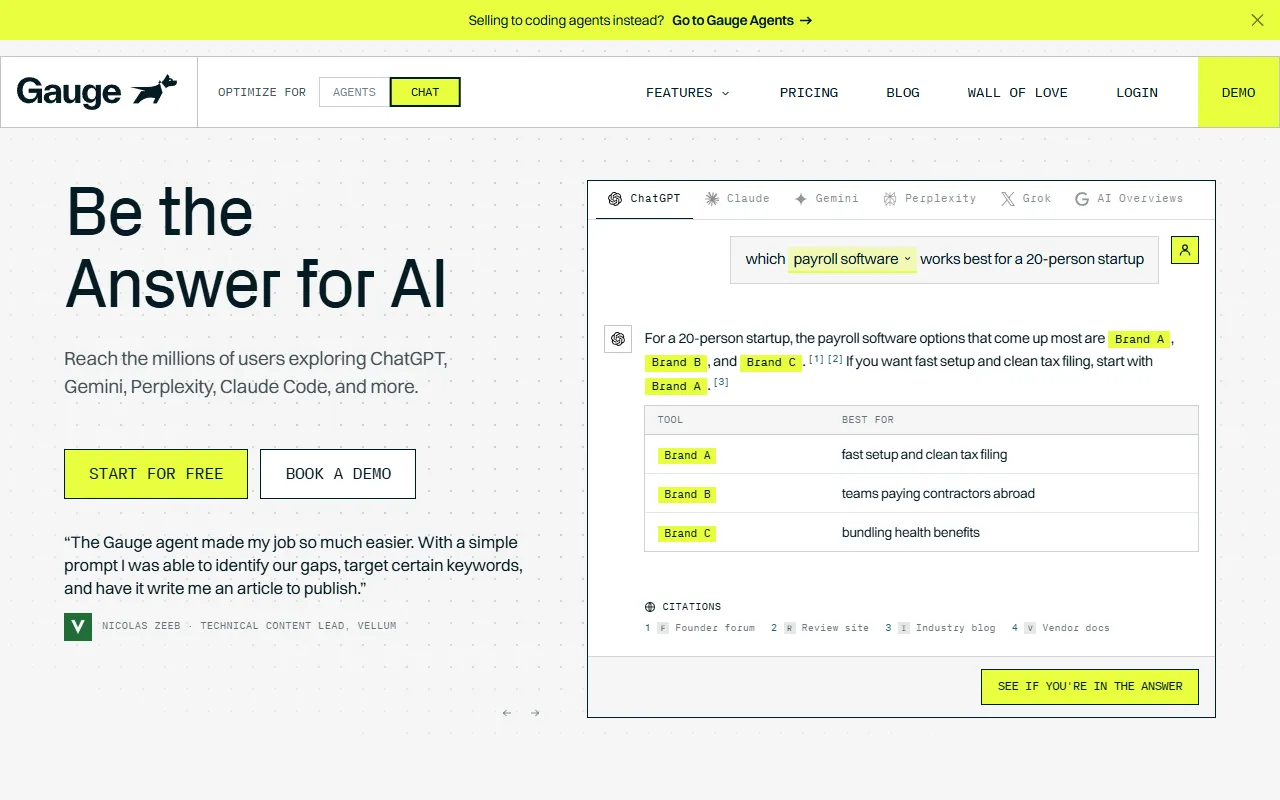
Gauge is an AI SEO tool that tracks and analyzes brand presence across AI platforms for optimization. Gauge is a paid tool. A free trial is available. It is aimed at marketing professionals, businesses and digital marketers.
Tracks and analyzes brand presence across AI platforms like ChatGPT, Gemini, and Perplexity. It offers tools for AI visibility, GEO optimization, and content performance analysis. Designed for marketing professionals and businesses aiming to improve their AI-driven search presence.
Built for marketing professionals, businesses, digital marketers and seo specialists.
Features
Track AI-Generated Answers
Monitors brand presence in AI-generated responses across platforms.
Analyze Content Citations
Evaluates content citations, sentiment, and competitor performance.
Generate AI-Optimized Content
Creates content tailored for AI search optimization and direct CMS publishing.
Connect Measurement to Execution
Search and Performance Analysis
AI Marketing Co-Pilot
Assists with GA4 data and AI-driven marketing insights.
Use cases
- Track brand presence in AI-generated answers across ChatGPT, Gemini, and Perplexity
- Analyze content citations, sentiment, and competitor performance for marketing strategies
- Generate AI-optimized content and publish directly to a CMS
- Connect performance data to execution with Gauge's measurement tools
- Analyze search performance and AI platform metrics for optimization
- Use AI marketing co-pilot to access GA4 data and insights
Pros & cons
Pros
- Public API available
- Free trial available
- Custom and enterprise pricing options
Cons
- No free plan available
Pricing
Paid. Free trial available.
| Plan | Price |
|---|---|
| Growth plan | $599 |
Developer & API
Public CLI API available
Security & compliance
- HIPAA
As stated on Gauge's website — not independently verified by AiByts.
FAQ
What is Gauge?
Gauge is an AI SEO tool that tracks and analyzes brand presence across AI platforms for optimization. Tracks and analyzes brand presence across AI platforms like ChatGPT, Gemini, and Perplexity. It offers tools for AI visibility, GEO optimization, and content performance analysis. Designed for marketing professionals and businesses aiming to improve their AI-driven search presence.
Is Gauge free?
No, Gauge is a paid tool. A free trial is available.
How much does Gauge cost?
Gauge offers one plan: Growth plan ($599).
Does Gauge have an API?
Yes, Gauge offers a public CLI API for building custom integrations.
Who should use Gauge?
Gauge is built for marketing professionals, businesses, digital marketers, seo specialists and content marketers. Common uses: track brand presence in AI-generated answers across ChatGPT, Gemini, and Perplexity, analyze content citations, sentiment, and competitor performance for marketing strategies, generate AI-optimized content and publish directly to a CMS and connect performance data to execution with Gauge's measurement tools.
What are the best alternatives to Gauge?
Similar tools on AiByts include Dageno AI, Omnia, NotFair, Nightwatch AI Tracking and SchemaWriter.ai.
Gauge news & updates
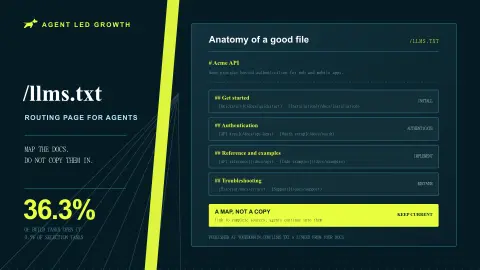
How to Write a Good llms.txt File (2026)
An llms.txt file is a routing page for coding agents, not a copy of your documentation. Where to put it, how to group the links, and what to check before you ship it.
Gauge Blog4 min read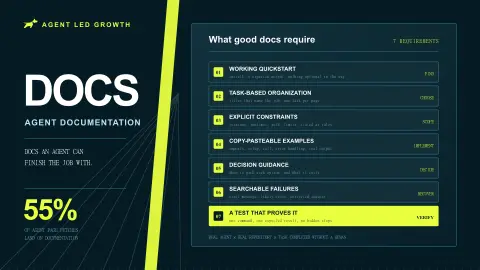
What Makes Good Agent Documentation? Complete Guide (2026)
Documentation took 55% of page fetches across 500 tracked coding-agent runs. Seven requirements for docs an agent can finish a real task with, plus a method for testing them the way an agent would use them.
Gauge Blog12 min read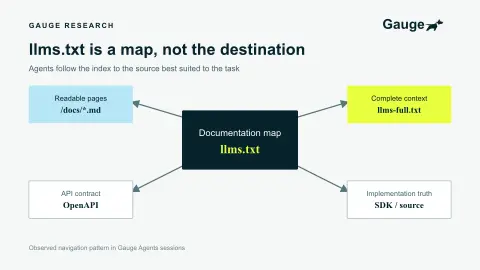
Should you have an llms.txt?
Absolutely yes. Coding agents use llms.txt to understand your product and navigate your documentation, and our research shows how often they read it.
Gauge Blog3 min read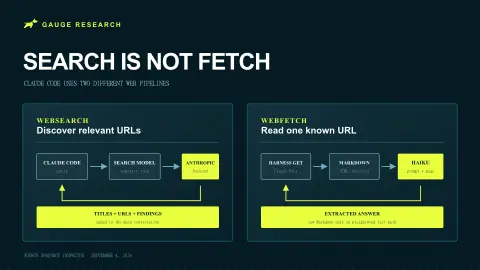
How Claude Code Searches the Web
Claude Code uses two separate web pipelines: a server-side search that returns links and findings, and a local fetch that sends a page through Markdown conversion and usually a Haiku extraction pass.
Gauge Blog10 min read
Open Models Are Useful Proxies for Claude and Codex Preferences
Open models show similar preferences compared to Claude and Codex across 1,000+ sessions. That makes them useful for efficiently finding opportunities.
Gauge Blog4 min read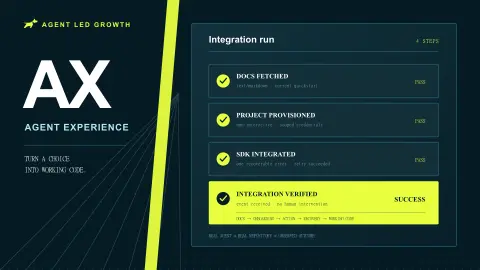
What is Agent Experience?
Agent Experience is the practice of making products easy for AI agents to discover, understand, use, and recover with. Learn how to measure AX and improve docs, onboarding, errors, URLs, and APIs.
Gauge Blog11 min read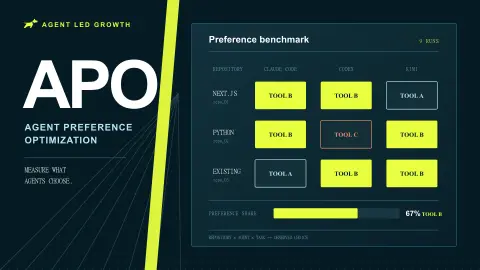
What is Agent Preference Optimization?
Agent Preference Optimization is how companies measure and improve whether coding agents choose their product. Here is how to establish a baseline, understand why competitors win, act on the evidence, and track the result.
Gauge Blog12 min read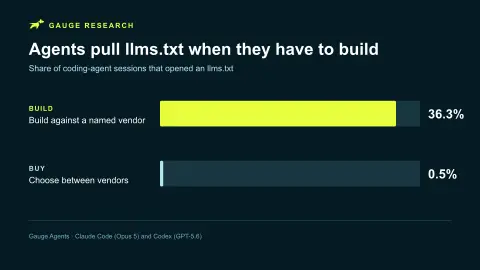
What Is llms.txt Used For? Data From Opus 5 and GPT-5.6 Sessions
Coding agents opened llms.txt in 36.3% of build sessions, but only 0.5% of vendor-selection sessions. The task determines whether the file matters.
Gauge Blog3 min read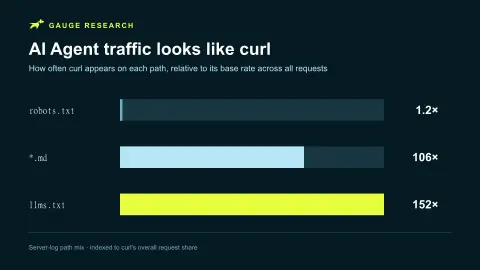
Does Codex Read llms.txt? You Have to Look in the Right Place
Server logs showed no ChatGPT-User requests for llms.txt. Instrumented sessions showed exactly where those reads went.
Gauge Blog3 min read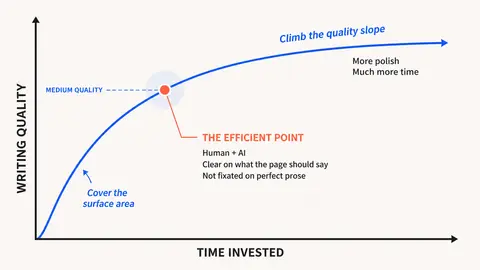
Write Medium-Quality Content
Humans should decide what content says, AI should write most of the prose, and humans should review the result.
Gauge Blog11 min read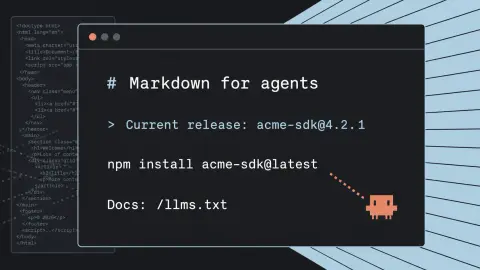
How and Why You Should Serve Markdown Pages to Agents
Serve a Markdown version of every docs URL so agents get cleaner context, current package versions, exact install commands, and a map of your docs.
Gauge Blog9 min read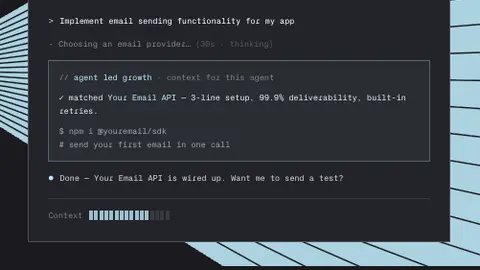
What is Agent Led Growth? How Coding Agents Choose Software
Coding agents now choose and install the tools developers build with. Agent Led Growth is the channel that decides which tool wins, and it has two halves: get recommended, then get implemented properly.
Gauge Blog8 min read
How PostHog uses Gauge to win AEO
How Natalia Amorim used Gauge to Increase Posthog LLM Traffic 41x.
Gauge Blog7 min read
Expect Higher Visibility on Grok. Lower on Perplexity. A Study of Brand Mentions from 17M+ Answers
Grok mentions more than double than brands Perplexity does while OpenAI and Anthropic land in the middle.
Gauge Blog4 min read
How Braintrust Built a Marketing Engine for the AI-Native Buyer
How Braintrust's Head of Growth Marketing, Raman Hundal, built an AI-search content engine from scratch and grew their visibility from 2.5% to 45% of AI answers in their space.
Gauge Blog7 min read
ChatGPT Ads: What to Track and How Gauge Makes It Easy via MCP
ChatGPT ads are live and self-serve. Here's what to track, how they differ from Google Ads, and how Gauge connects paid performance to organic AI visibility via MCP.
Gauge Blog6 min read
Why First-Party Content Is the Highest-Leverage Move in GEO
Understanding the different forms of content, and why first party content is the most effective strategy for GEO.
Gauge Blog8 min read
Full Guide to Tracking and Fixing AI Brand Sentiment
Complete guide to understanding how AI speaks about your brand and how to optimize for it.
Gauge Blog11 min read
Details are compiled from Gauge's website and public sources, last verified Oct 4, 2026. Features and pricing change — confirm on the official site before you buy.
Try Gauge
Paid
Tags
- AI Visibility
- GEO Optimization
- Content Citations
- AI-Optimized Content
- Search Performance
Comments
Sign in to join the discussion.