v0.7.0
LLM inference in C/C++. Contribute to ggml-org/llama.cpp development by creating an account on GitHub.
llama.cpp11 min read
Stay updated with the latest developments in Artificial Intelligence
LLM inference in C/C++. Contribute to ggml-org/llama.cpp development by creating an account on GitHub.


Masks let a blur, a grade or a glow affect one region instead of everything. Where the feather setting matters more than the shape.
Keyframes are just two values and a line between them. What the line does is where all the difference is, and it is the part most tutorials skip.
Undo runs out and autosave only holds the latest state. Version snapshots are the thing that gets you back to the cut that was working.
Two shots that were fine separately look wrong next to each other. How to fix it with your eyes, and how to fix it with scopes when your eyes lie.
Two effects that are trivial to apply and easy to overuse. Where a freeze earns its place, and the audio problem reversing always creates.
Two videos, one vertical frame. How to size the panels so both stay readable, how to handle two audio tracks, and where reaction edits usually go wrong.
A photo that appears exactly when you name the thing. How the timing works, why tilted cards read better than full-frame images, and how many is too many.
What actually happens to your edit when an app quits unexpectedly, where the recovery data lives, and the one habit that makes the question moot.
Most "templates" are a filter and a font. A real one restructures the video: captions, cuts, zooms and pacing together. What each of the seven does.
It saves your edits, not your video, and that distinction explains almost everything else about it - including why recovery is instant.
There is an actual answer, and it is lower than you think. A working density rule, the tune-out effect, and how to tell if you have crossed the line.
Movement is not automatically better. A short test for whether a move is doing work, and the specific cases where holding still is the stronger choice.
The slow pan and zoom that makes a still photo work in a video. The two rules that separate it from a photo that just moves around.
A locked-off shot of a person talking reads as a paused video. A slow push-in fixes it, costs nothing, and is invisible when done at the right speed.
B-roll is not decoration, it is a cut you do not have to justify. Where to put it, how long to hold it, and how to stop it looking like a stock footage reel.
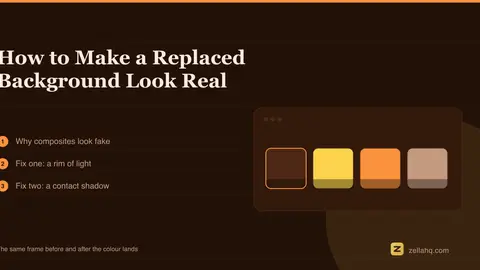
Cutout edges are only half the problem. The two lighting cues that make a composite read as a person in a room rather than a sticker on a picture.
The first line you say is usually the best title you will ever write. Here is how to get it on screen, and why a still opening frame costs you viewers.
A whoosh under a cut is the most reliable polish in short form, and the most overdone. Which sound goes under which cut, and why spacing beats choice.
Showing 18 of 30 stories
Load more storiesGet the top AI news and tools straight to your inbox every week.
Weekly · AI news from Zella Blog
Join 15,000+ AI enthusiasts