Structure Beats Instruction: Why AI Agent Prompt Rules Fail (2026)
A mandated clarifying-question rule fired on 0 of 4 arms. Removing the broader rule it lost to restored it on 4 of 4. Why structure beats instruction, measured.
45 stories
A mandated clarifying-question rule fired on 0 of 4 arms. Removing the broader rule it lost to restored it on 4 of 4. Why structure beats instruction, measured.
Vercel and Bryo AI report faster, cheaper results with Jev. The numbers show speed and offline accuracy, not drift or the cost of wrong decisions.
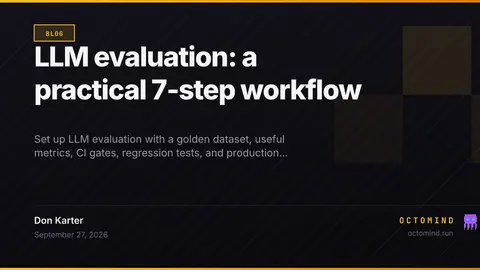
Set up LLM evaluation with a golden dataset, useful metrics, CI gates, regression tests, and production feedback. A practical workflow for engineers.
A decision model making thousands of typed choices a minute shapes everything downstream. Its silent mistakes compound, so it needs more scrutiny, not less.
Jev's confidence score is calibrated on TypeSafe's training data, not your traffic. Until you compare it to real outcomes per run, you cannot act on it.
Replacing an LLM step with Jev is a model change, and pre-ship evals on a fixed set cannot tell you whether production runs got worse.
We spent a year teaching an AI agent to remember. The headline feature returned null on 31 of 31 calls. What failed, why, and the two things that worked.
A Jev router that sends a hard request to a cheap model logs a clean 200 and a cost saving. The wrong answer lands on the customer, not in your logs.
Jev guarantees a valid instance of the requested type, not a correct decision. Typed outputs still require behaviour evals to catch semantic errors.
We’re on a journey to advance and democratize artificial intelligence through open source and open science.
Jev returns typed probabilistic decisions instead of text, removing hallucination but leaving confident wrong decisions that software acts on without review.
Silent quality drift in production AI agents is detectable within 24 to 48 hours using canary evaluation. Infrastructure metrics alone cannot catch it.
Empty responses and silent tool failures return HTTP 200 and close spans normally. Span-level output validation catches what status checks miss.
Stable benchmarks require fixed inputs, defined success criteria, and consistent instrumentation. Varying only one factor at a time makes results comparable.
Outcome metrics miss step-level failures that compound across runs, creating a 35-point gap between benchmark scores and production success rates.
A cascade starts when one step returns a plausible wrong output and later steps build on it. Boundary validation and checkpoints contain it; retries do not.
Final-output benchmarks hide compounding failures. Instrumenting each step shows where accuracy drops and why workflows fail at scale.
Silent output degradation is the leading cause of cancelled agent projects. Score per span, baseline tool calls, and trace full paths to catch it early.
Showing 36 of 45 stories
Load more storiesGet the top AI news and tools straight to your inbox every week.
Weekly · AI news
Join 15,000+ AI enthusiasts