Does Jev model routing need evaluation? The unmeasured failure
A Jev router that sends a hard request to a cheap model logs a clean 200 and a cost saving. The wrong answer lands on the customer, not in your logs.
Prefactor Blog6 min read
38 stories
A Jev router that sends a hard request to a cheap model logs a clean 200 and a cost saving. The wrong answer lands on the customer, not in your logs.
Jev guarantees a valid instance of the requested type, not a correct decision. Typed outputs still require behaviour evals to catch semantic errors.
We’re on a journey to advance and democratize artificial intelligence through open source and open science.
Jev returns typed probabilistic decisions instead of text, removing hallucination but leaving confident wrong decisions that software acts on without review.
Silent quality drift in production AI agents is detectable within 24 to 48 hours using canary evaluation. Infrastructure metrics alone cannot catch it.
Empty responses and silent tool failures return HTTP 200 and close spans normally. Span-level output validation catches what status checks miss.
Stable benchmarks require fixed inputs, defined success criteria, and consistent instrumentation. Varying only one factor at a time makes results comparable.
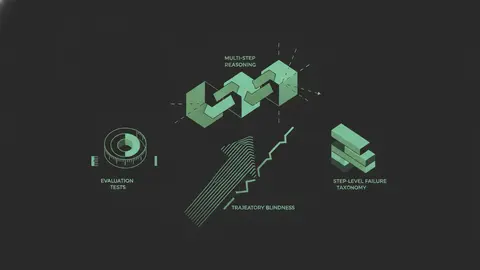
Outcome metrics miss step-level failures that compound across runs, creating a 35-point gap between benchmark scores and production success rates.
A cascade starts when one step returns a plausible wrong output and later steps build on it. Boundary validation and checkpoints contain it; retries do not.
Final-output benchmarks hide compounding failures. Instrumenting each step shows where accuracy drops and why workflows fail at scale.
Silent output degradation is the leading cause of cancelled agent projects. Score per span, baseline tool calls, and trace full paths to catch it early.
At 85% per-step accuracy, a ten-step agent completes the whole task about one time in five. Final-output scoring cannot see this; trajectory evaluation can.
At 95% per-step accuracy, a 10-step agent succeeds only 59% of the time. Step-level spans show which step fails and why.
Activity schemas and validation suites let you catch policy violations and capability regressions in AI agents before they reach production.
Step repetitions cause 17% of multi-agent failures and reasoning-to-action mismatches cause 14%, both undetected by final-output evaluation.
Behavior deviation detection, reasoning artifact capture, and adversarial prompt detection run continuously so human reviewers act on signals, not haystacks.
Span-based instrumentation and activity schemas surface prompt injection, unauthorized access, and multi-turn drift before incidents compound.
Span records, not prompt logs, are what make AI agent investigations possible. Each field you skip is a gap you cannot close after the fact.
Showing 36 of 38 stories
Load more storiesGet the top AI news and tools straight to your inbox every week.
Weekly · AI news
Join 15,000+ AI enthusiasts